

Advanced early warning systems for harmful plankton in Scottish aquaculture
Early detection and forecasting of harmful plankton events.
Project summary
Partners: Scottish Sea Farms, Scottish Association for Marine Science, UHI Shetland, University of Aberdeen, Mowi, Bakkafrost
Funder: Sustainable Aquaculture Innovation Centre (SAIC)
Authors: Keith Davidson, Ralph Bickerdike, Debi Brennan, Kimberly McKinnell, Dmitry Aleynik, Gregg Arthur, Tim Szewczyk, Thangavel Thevar, Callum Whyte
Impact
The project demonstrated that continuous, real-time, farm-based plankton monitoring is technically robust and operationally feasible in Scottish conditions.
£716,127
Total value
Case study
Download
BACKGROUND
The Scottish salmon sector is increasingly affected by blooms of harmful plankton, including harmful algal blooms (HABs), micro-jellyfish and hydrozoans. These organisms can cause significant damage to the gills of farmed fish, compromising their welfare. Their increasing frequency and severity are linked to environmental change, including warming waters and changing environmental conditions that favour bloom formation. Early detection and forecasting of harmful plankton events are therefore critical to enable timely mitigation measures.
The Plankton-Predict project described in this case study built on earlier SAIC-funded HAB initiatives, including real-time modelling and prediction systems. Previous work had demonstrated proof-of-concept real-time phytoplankton enumeration using an Imaging FlowCytobot (IFCB) at an operational finfish aquaculture site in Shetland, enabling high-frequency monitoring and reporting. The system was limited to phytoplankton within a specific size range and it is not designed to detect larger harmful organisms such as micro-jellyfish.
In parallel, hydrodynamic modelling systems (WeStCOMS and NORSCOMS) had already been developed and validated for bloom dispersal forecasting, and ensemble statistical models had been successfully applied in shellfish aquaculture to forecast toxin-producing plankton taxa. This case study aimed to extend these technological and modelling capabilities into operational salmon farming environments, integrating enhanced monitoring, environmental profiling and predictive modelling to strengthen early warning capacity.
The project was led by Scottish Sea Farms, with academic leadership from the Scottish Association for Marine Science (SAMS), and included collaborations with UHI Shetland, the University of Aberdeen, Mowi, and Bakkafrost.
AIMS
The project had three primary objectives:
- To develop and deploy a holographic imaging system capable of detecting harmful micro-jellyfish at aquaculture farms;
- To install and operate an automated water column profiling system to monitor harmful plankton (including HABs and micro-jellyfish) alongside key environmental conditions, providing improved information to support fish health management;
- To test statistical ensemble models of harmful plankton bloom development, originally developed for Scottish shellfish aquaculture, in a fish farm setting to strengthen early warning of HABs.
METHODS AND RESULTS
Plankton-Predict combined in situ monitoring, environmental profiling, hydrodynamic modelling and statistical forecasting to improve early warning of harmful plankton events affecting Scottish salmon farms. The work was structured across three technical work packages, delivered within an established modelling and data-sharing framework.
The project operated within the existing www.HABreports.org platform and the IFCB Portal (https://ifcb-portal.sams.ac.uk/), which provides data visualisation and cross-industry sharing of HAB information. During the project, the IFCB Portal was upgraded to improve usability and reporting functionality.
Hydrodynamic forecasting was provided through the NORWESTCOMS system, which integrates the WRF atmospheric model with the FVCOM coastal ocean model. The upgraded WeStCOMS v3 configuration increased spatial resolution in aquaculture-relevant areas while maintaining computational efficiency. Model outputs include currents, temperature and salinity fields and are made available through SAMS data portals. This modelling framework supports bloom transport simulations and early warning alerts.
Environmental profiling and automated monitoring
At the Cole Deep salmon farm in Shetland, an Imaging FlowCytobot (IFCB) was deployed for continuous, real-time plankton monitoring. The IFCB captures images of phytoplankton in situ and uses automated image classification to estimate cell abundance at high temporal frequency.
An AML CTD sonde was integrated with the IFCB to measure temperature, salinity, pressure, oxygen and chlorophyll. Environmental data were streamed in real time to onshore servers and visualised through the IFCB Portal.
To enable vertical profiling, a bespoke davit and programmable winch system were designed and installed. A Raspberry Pi-based control system issued scheduled commands to move the instrument payload between five depths (5, 8, 11, 17 and 23 m), holding for two hours at each depth over a repeating four-day cycle. Three full-depth CTD transects per day were also programmed. Depth feedback from the AML sonde was used to calibrate winch positioning.
Machine learning tools were refined in parallel with hardware deployment. A new image classifier was developed, addressing limitations of the previous model, alongside automated morphology measurements and genus-specific diatom chain-counting models. These tools were integrated into the IFCB data pipeline to improve taxonomic resolution and quantitative accuracy.
The IFCB operated continuously at a Shetland finfish site
throughout the project, maintaining the only long-term 24/7 in situ automated plankton monitoring deployment at an aquaculture site worldwide. Between February 2023 and December 2025, 78 million images were collected.
Although the bespoke winch system experienced manufacturing and firmware-related faults that limited extended automated profiling during the project period, these issues were identified as supplier-related and rectifiable. When operational, the profiling system successfully sampled plankton and environmental parameters across the programmed depth range without identifying any sampling artefacts.
Machine learning classification improved during the project. Cross-validation with Scottish Sea Farms’ laboratory monitoring data showed good correlation between IFCB-derived phytoplankton counts and microscopy/FlowCam results, with minor differences attributed to sampling methodology.
Hydrodynamic modelling upgrades improved the representation of coastal currents.
Comparison of WeStCOMS v3 outputs with observational current meter data showed improved correlation of M2 tidal constituent speeds (increasing from 0.54 to 0.66 relative to v2). Temperature validation exercises demonstrated strong agreement between modelled and observed values, with correlations exceeding 0.96 in 2025 comparisons. These improvements strengthened the operational HAB forecasting framework.
Statistical HAB forecasting
The second work package adapted ensemble machine learning and Bayesian modelling approaches, previously developed for shellfish aquaculture, to salmon farm monitoring data.
The modelling framework aggregated predictions from multiple constituent models, including ridge regression, random forests, neural networks and multilevel Bayesian approaches, and combined them using an ensemble model to improve forecast stability and accuracy.
Given the relatively short time series and rarity of bloom events in the finfish dataset, modifications were made to partitioning, cross-validation and model structure to reduce over-fitting and improve out-of-sample performance. Models were developed to predict the probability that cell abundance would exceed industry-defined bloom thresholds.
Industry datasets included 79,000 observations across 65 sites and 17 taxa between March 2023 and May 2025. However, 87.7% of observations were zeroes, and bloom events above management thresholds were rare.
Full ensemble models were developed for Alexandrium spp., Chaetoceros convolutus, Pseudo-nitzschia and Gymnodinium spp. The strongest predictive performance was achieved for Chaetoceros convolutus, with an average skill score of 0.479 relative to a null model and peak skill in July, when bloom frequency was highest.
Lower skill scores for other taxa reflected the limited number of bloom observations available for model training (e.g. Alexandrium with four blooms in the testing subset; Gymnodinium with one). Results demonstrated that ensemble forecasting is technically feasible in finfish aquaculture settings but is currently constrained by short time series and bloom rarity. Continued data collection is expected to improve model performance.
Holographic micro-jellyfish detection
The third work package sought to develop a subsea holographic imaging system to detect harmful micro-jellyfish and hydrozoans that are too large to be captured by the IFCB.
The holographic system was centred around a pulsed green laser and a large (20 x 20 mm) image sensor with 2.5 µm pixels. Three pressure-rated aluminium housings, for the laser, image sensor and control electronics were designed. The system used a microcontroller to synchronise laser pulses and image capture, with power and Ethernet delivered via tether to a topside PC. Hologram reconstruction and particle extraction were performed on site in real-time using FPGA-accelerated software, with particle images stored for classification.
The holographic imaging system was successfully constructed, pressure-tested (at 10 bars) and deployed at the Cole Deep site in August 2025. The system operated reliably and recorded approximately 100 GB of particle images during close to 3 months of continuous deployment. Among these images were a good number of micro-jellyfish and hydrozoans. Some sample images are shown below.
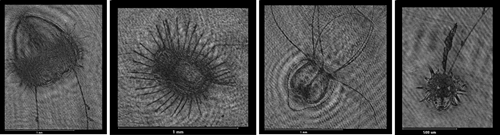
The objective of developing and deploying a holographic imaging system to identify harmful micro-jellyfish at aquaculture sites was achieved as proof of concept. Integration with an AI-based jellyfish classifier is planned for future deployments.
IMPACT
The project team successfully achieved its three core objectives: deployment of automated plankton and environmental profiling at a salmon farm, testing of ensemble statistical HAB forecasting in a finfish setting, and development and deployment of a holographic imaging system for micro-jellyfish detection.
The project demonstrated that continuous, real-time, farm-based plankton monitoring is technically robust and operationally feasible in Scottish conditions.
Enhancements to hydrodynamic modelling and statistical ensemble forecasting strengthen early warning systems and provide probability-based risk estimates. While predictive performance is currently limited by short time series and rare bloom events, continued data collection and industry collaboration are expected to increase forecasting reliability.
The holographic imaging system provides a new capability for automated detection of harmful micro-jellyfish, addressing a recognised monitoring gap.