

Integrating catchment and loch models to assess phosphorus loading in freshwater salmonid aquaculture
This project developed an integrated modelling approach that combined catchment phosphorus export with loch phosphorus dynamics.
Project summary
Partners: Mowi Scotland, Institute of Aquaculture (University of Stirling), Dawnfresh Seafoods, Scottish Environment Protection Agency, Aquaculture Stewardship Council
Authors: Trevor Telfer, Meredith Burke
Impact
£563,283
Total value
Case study
Download
BACKGROUND
Freshwater lochs used for salmonid farming are productive but sensitive systems. In Scotland, many of these lochs are naturally low in nutrients and are influenced not only by aquaculture activity, but also by rainfall, land use across large catchments, and, in some cases, managed water flows. For operators and regulators, the key challenge is understanding how much production a loch can support at different times of year while maintaining environmental standards.
Traditional approaches to managing freshwater farming sites have often relied on individual loch models or site-specific monitoring data. While effective for demonstrating compliance, these approaches offer limited insight into how catchment inputs interact with aquaculture-derived nutrients or how conditions may vary seasonally. As production planning, licence variation, and climate pressures increase, there is a growing need for practical tools that can link catchment-scale nutrient inputs with loch-scale responses.
This project addressed that need by developing an integrated modelling approach that combined catchment phosphorus export with loch phosphorus dynamics. The work was carried out by the Institute of Aquaculture at the University of Stirling in partnership with Mowi Scotland, with support from the Sustainable Aquaculture Innovation Centre, and focused on lochs currently used for freshwater salmonid farming.
AIMS
The project aimed to provide tools that support clearer, evidence-based decisions for freshwater aquaculture planning and regulation. The specific objectives were to:
- Link catchment phosphorus export and loch phosphorus concentrations within a single, consistent modelling workflow.
- Adapt established models so they perform reliably in Scottish Highland catchments and lochs.
- Test model outputs against long-term monitoring data from operational freshwater farming sites.
- Assess both annual and seasonal phosphorus dynamics relevant to licensing, compliance, and site management.
- Demonstrate how the approach can be used in regulatory, licensing and sustainability contexts.
LOCHS, CATCHMENTS AND MONITORING DATA
Four Scottish Highland lochs were selected for the study: Loch Arkaig, Loch Lochy, Loch Shiel and Loch Garry. All four support salmonid aquaculture and represent a range of loch sizes, depths, catchment characteristics, and levels of hydrological modification (Table 1). Three of the lochs have regulated outflows associated with hydroelectric or flood management infrastructure, while Loch Shiel remains largely unmodified.
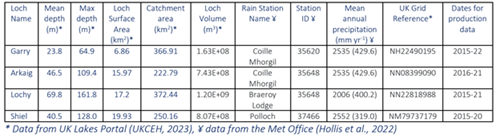
Table 1. Details of the four Scottish lochs used in the study. Mean annual precipitation (standard deviation) between 2015 and 2022.
Each loch benefits from long-term total phosphorus monitoring carried out by the University of Stirling, with datasets extending back several decades. Water samples were collected multiple times per year from several locations and depths within each loch using standardised sampling and analytical methods. These datasets provided a robust basis for testing model performance across both annual averages and seasonal conditions.
Aquaculture production data supplied by Mowi Scotland, including feed use, phosphorus content of feed and fish, and annual production figures, were used to estimate phosphorus inputs from fish farming. Analysis focused on the period from 2015 to 2022, where monitoring, land-use, and climate data were most consistent.
Phosphorus inputs from each loch catchment were estimated using the InVEST Nutrient Delivery Ratio (NDR) model. This model utilises land cover, topography, and rainfall data to estimate the amount of phosphorus exported from various parts of a catchment to surface waters.
The model was parameterised using nationally available datasets, including UK land cover maps and Met Office rainfall data. Published phosphorus export values for different land uses were applied, allowing consistent estimates of annual phosphorus loading from each catchment. These outputs represent non-point source inputs and provide a catchment-wide context for the loch nutrient status.
LOCH PHOSPHORUS MODELLING
Three established loch models were used to simulate phosphorus concentrations:
- Two static models (Dillon and Rigler, and OECD) that predict mean annual phosphorus concentrations based on total loading and hydrological characteristics;
- One dynamic model (LakeMab) that simulates phosphorus concentrations at high temporal resolution, capturing seasonal variation and internal loch processes.
Mean annual loch outflows were estimated using a published hydrological equation, which was calibrated for Scottish Highland conditions using flow data from Loch Shiel. This adjustment improved the representation of rainfall-driven runoff typical of steep, peat-dominated catchments.
Catchment-derived phosphorus and aquaculture-derived phosphorus were combined within each model. Model outputs were compared with measured loch phosphorus concentrations using standard error metrics to assess how well each approach reproduced observed conditions.
RESULTS
Long-term monitoring data show that all four lochs have remained oligotrophic throughout the study period, with total phosphorus (TP) concentrations generally below recognised trophic thresholds. Sampling revealed clear seasonal variability within each loch, alongside relatively stable annual mean concentrations.
Lochs Arkaig, Lochy and Garry showed no consistent long-term increase in annual mean TP concentrations over the monitoring period, despite year-to-year variability linked to seasonal conditions. In contrast, Loch Shiel exhibited a gradual increase in TP concentrations from the early 1990s onwards. Nevertheless, TP concentrations in Loch Shiel remained within the oligotrophic range throughout the study period.
Seasonal ranges differed between lochs. Lochs Arkaig and Lochy showed comparatively narrow seasonal ranges, typically between approximately 3 and 9 µg L⁻¹ TP, while Loch Garry displayed wider variability, with concentrations ranging from around 2 to 12 µg L⁻¹. These differences reflect variation in catchment size, hydrology, and the extent of anthropogenic modification across the systems.
Performance of static loch models
When catchment phosphorus export and aquaculture-derived phosphorus inputs were combined, both static loch models produced reasonable predictions of mean annual TP concentrations.
The Dillon and Rigler model generally produced predictions that were slightly higher than the measured TP concentrations for Lochs Arkaig, Lochy and Shiel, but lower than the measured values for Loch Garry. The OECD model showed a similar pattern, with predicted TP concentrations generally exceeding measured values for Lochs Arkaig, Lochy and Shiel, and underpredicting concentrations in Loch Garry.
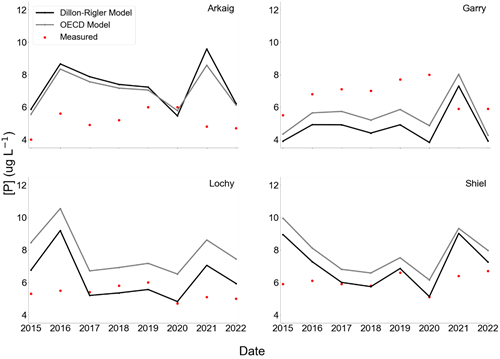
Figure 1. Loch annual TP predicted by the Dillon & Rigler (1975) model (blue line) and the OECD (1982) model (red line) with input from aquaculture and catchment (InVEST), compared to the mean annual measured observations (black line) for Lochs Arkaig, Garry, Lochy, and Shiel.
Root mean squared error (RMSE) analysis showed that the Dillon and Rigler model provided the lowest average error across the lochs, with particularly good performance for Loch Lochy and Loch Shiel. The OECD model performed best for Loch Garry, where other models showed larger deviations from observed values.
Performance of the dynamic model
The LakeMab dynamic model provided predictions of TP concentrations at high temporal resolution, allowing seasonal patterns and within-year variability to be examined. Model outputs showed good agreement with measured data for Lochs Arkaig and Shiel, capturing both the magnitude and timing of seasonal changes in TP concentrations.
For Loch Lochy, the LakeMab model slightly overpredicted TP concentrations, with a mean predicted value of 6.7 ± 1.9 µg L⁻¹ compared to a measured mean of 5.7 ± 0.8 µg L⁻¹. In contrast, the model consistently underpredicted TP concentrations in Loch Garry, with a mean predicted value of 3.3 ± 0.8 µg L⁻¹ compared to a measured mean of 7.0 ± 2.0 µg L⁻¹. This underprediction was observed across all modelling approaches and is attributed to the high degree of hydrological modification within the Loch Garry system, including managed drawdown and flood control associated with hydroelectric operations.
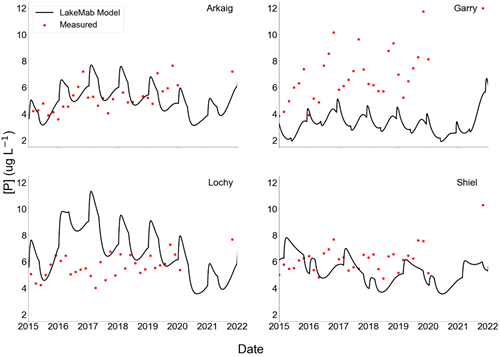
Figure 2. Loch annual TP predicted by the LakeMab (2008) model with input from fish farm and catchment (InVEST) in comparison to mean annual measured data (black line) for Lochs Arkaig, Garry, Lochy, and Shiel.
When RMSE values were compared across models, LakeMab showed the highest average error when assessed against annual mean values (Table 2). However, when differences in temporal resolution were taken into account, the dynamic model showed the strongest overall goodness of fit, reflecting its ability to represent seasonal processes that are not captured by static annual models.
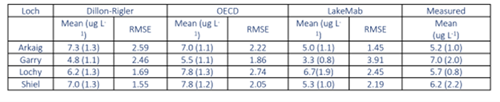
Table 2. Mean loch TP predictions (standard deviation) and Root Mean Square Error (RMSE) for modelled data using Dillon and Rigler (1975) and OECD (1982), and LakeMab model (2008) compared to measured TP concentrations between 2015 and 2022.
Across all models, predictive accuracy varied according to the level of hydrological modification within each loch. Lochs with managed water levels and flows, particularly Loch Garry, were more difficult to model accurately using standard formulations. This highlights the importance of accounting for operational hydrology and water management practices when applying phosphorus models to freshwater aquaculture systems.
IMPACT
This project demonstrates that combining catchment-scale and loch-scale models provides a practical and credible way to assess phosphorus loading and carrying capacity in freshwater lochs used for salmonid farming.
The integrated modelling approach has been submitted to the Scottish Environment Protection Agency as part of an active licence application, indicating its potential suitability for regulatory use. It is already being applied by aquaculture companies to support planning and development decisions at freshwater sites.
For the industry, the approach offers a clearer understanding of how catchment inputs and aquaculture activity interact, reducing uncertainty around production limits and environmental risk. The ability to assess both annual conditions and seasonal variability supports more informed decisions on site operation, expansion, and long-term planning.
Because the models rely on widely available data and established methods, the approach is transferable to other freshwater lochs and catchments, and potentially to freshwater farming systems beyond Scotland. More broadly, the work supports a move towards integrated catchment management, helping ensure that freshwater aquaculture development is both environmentally sustainable and operationally viable.